
Your complete guide to planning the perfect Rainbow Mountain adventure.
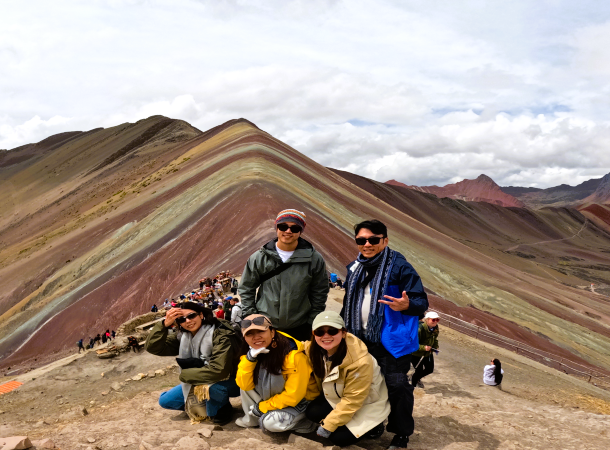
Table of Contents
Essential Information
To visit Rainbow Mountain (Vinicunca), travelers must first fly into Lima and then take a domestic flight to Cusco, the closest major city and airport. From Cusco, the only way to reach the trailhead—located 3.5 hours away—is by car.
Once at the trailhead, you can:
- Hike to the summit (about 1.5 hours one-way)
- Ride a horse, operated by local residents (around 40 minutes)
Entrance tickets are purchased at the checkpoint near the trailhead—they cannot be bought in Cusco.
You may travel independently or book through a local travel agency (highly recommended for safety and logistics).
Keep in mind that Cusco sits at 11,152 ft and Rainbow Mountain reaches 16,522 ft, so proper acclimatization is essential. Bring any personal medication, hydration salts, and appropriate gear to prevent altitude-related issues.
When to Visit
Although Rainbow Mountain is open year-round, the best time to visit is during the dry season, from May to September. Weather in the Andes can be unpredictable, but this season offers the most stable conditions and the clearest views.
Animals You May See
The region is home to incredible Andean wildlife, including:
- Herds of llamas and alpacas in their natural habitat.
- Birds such as Andean condors, Andean geese, wild ducks, water hens, caracaras, hawks, and hummingbirds—some of which are considered vulnerable
- Horses, used by locals as transportatio.
- Local dogs, often accompanying villagers and shepherds
Quick Travel Facts
- Time Zone: UTC-5
- Currency: Peruvian Sol (S/)
Where to Stay in Cusco
Cusco offers a wide range of accommodations:
- Hostels & 2-Star Hotels: Budget-friendly, basic, social. $15- $30 USD per night.
- Airbnbs: Great for families, groups and longer stays. $50–$90 USD per night.
- 3–5 Star Hotels: More comfort, full services, and amenities. $90–$650 USD per night.
Recommendations for Your Visit
- Choose an early-morning tour. Weather is more stable in the morning, and crowds are smaller. Companies like Inca Vision Tours pick up guests between 4:30–5:00 AM.
- If you’re a strong hiker, head straight to the viewpoint for sunrise—conditions may worsen later.
- Avoid wearing metal accessories (rings, earrings) during afternoon tours; lightning risk is higher during storms.
- Book your tour at least 2 days in advance to ensure availability for transport and meals.
- Bring a good rain jacket, light poncho, and warm layers—mountain weather changes rapidly.
- Wear proper hiking boots with good grip, as the trail can be rough and slippery, especially during snow or rain.
- Trekking poles are essential—they help on both dry, loose ground and muddy sections.
- Take photos whenever visibility is good; fog can roll in quickly.
- Bring snacks and water, as the journey from Cusco to the trailhead is long.
- If you’re planning to fly back to Lima the same day, choose a tour that picks you up around 3:00 AM.
Scientific Facts About Rainbow Mountain (Vinicunca)
- Its Colors Come from Mineral Sedimentation
Rainbow Mountain’s colorful stripes were formed by layers of minerals, each creating a different hue—iron oxide (red), iron sulphide (yellow), chlorite (green), calcium-rich sandstone (white), clay (pink), and magnesium-rich rocks (brown). Exposure and oxidation produced the vibrant rainbow appearance. - Most of the Andes—including Rainbow Mountain—Were Under the Ocean
These sediment layers formed underwater before being lifted by tectonic collisions between the Nazca and South American plates. - It Sits at Extremely High Altitude
At 5,200 m (17,060 ft), oxygen levels are lower, UV radiation is stronger, and weather changes rapidly. The harsh environment prevents plants from covering the colorful layers. - It Was Hidden Under Ice Until Recently
Rainbow Mountain was once covered by glaciers. As the ice melted in recent decades, its colorful layers were finally revealed. - The Colors Change with Weather and Moisture
Rain enhances the colors, dry conditions dull them, and snow or fog can temporarily hide them. The mountain’s look changes throughout the year. - It Is Part of a Volcanically Active Geological Zone
Although not a volcano, Rainbow Mountain lies within the Andean volcanic belt, where tectonic activity tilted and exposed the mineral layers. - Its Harsh Ecosystem Supports Unique High-Andean Life
Wildlife such as vicuñas, alpacas, Andean geese, lichens, and high-altitude grasses survive in this extreme environment - Erosion Continues to Shape the Mountain
Wind, rain, and temperature shifts constantly erode the surface, slowly altering the brightness and visibility of the colors over time.